
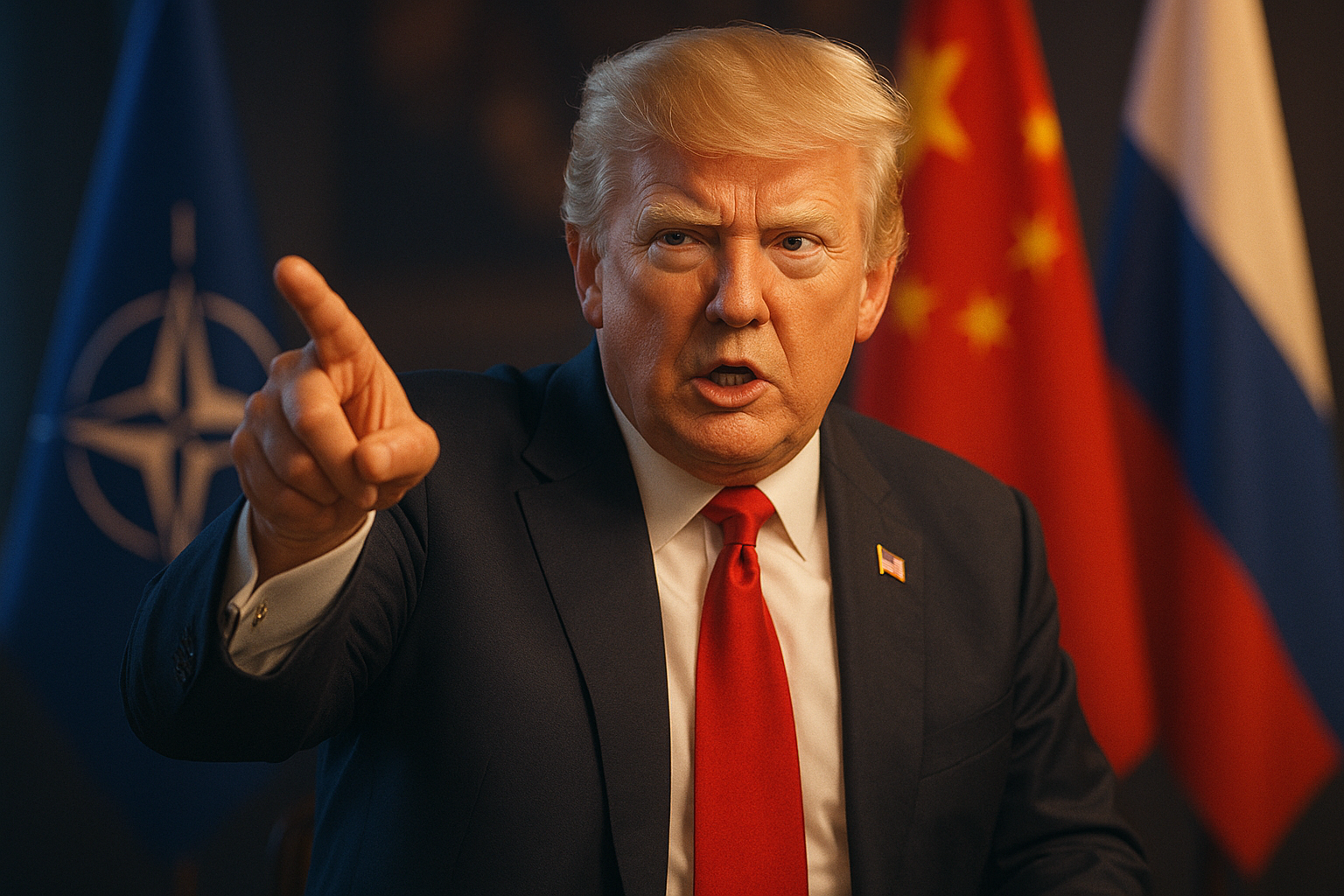
Former U.S. president calls for tariffs and sanctions as tools to end the Ukraine conflict
Former U.S. President Donald Trump has urged NATO allies to adopt sweeping tariffs of up to 100% on China as part of a strategy to pressure Moscow into ending the Russo-Ukrainian war. The proposal, delivered on Saturday, underscores Trump’s reliance on economic weapons as geopolitical leverage.
Trump’s proposal for NATO
“I believe that this, plus NATO, as a group, placing 50% to 100% tariffs on China, to be fully withdrawn after the war with Russia and Ukraine is ended, will also be of great help in ending this deadly, but ridiculous, war,” Trump declared.
He also announced plans for “major” sanctions directly on Russia, contingent on NATO members halting oil imports from Moscow. According to Trump, Europe’s continued energy purchases have weakened the alliance’s negotiating stance. “The purchase of Russian oil, by some, has been shocking. It greatly weakens your bargaining power over Russia,” he argued.
Oil trade complicates sanctions
Reports suggest that EU imports of oil derivatives routed through India have risen sharply in recent months. The U.S. administration under Trump imposed 50% tariffs on Indian crude exports, claiming that Russian oil was being re-exported under Indian branding.
Analysts say such measures highlight the challenges of enforcing sanctions in a globalized energy market. “As long as Russian oil finds indirect buyers, Moscow’s revenues remain intact, limiting the impact of Western restrictions,” noted a London-based energy strategist.
China’s response
China swiftly rejected Trump’s accusations. Foreign Minister Wang Yi stated in Ljubljana, “China does not participate in wars or plot them. War cannot solve problems, and sanctions only complicate them.”
Geopolitical stakes
Trump’s remarks reflect broader debates within NATO over how far economic tools should be pushed to influence Russia’s calculus. While tariffs and sanctions can pressure adversaries, they also risk disrupting global trade and escalating tensions with China — a key player in global supply chains.
For NATO, the question remains whether Trump’s tariff-driven approach would unify or divide allies facing a prolonged conflict in Ukraine.
Disclaimer
This content is for informational purposes only and does not constitute financial, investment, or legal advice. Cryptocurrency trading involves risk and may result in financial loss.
